Newsletter 03/2026: Actual situation in international transport
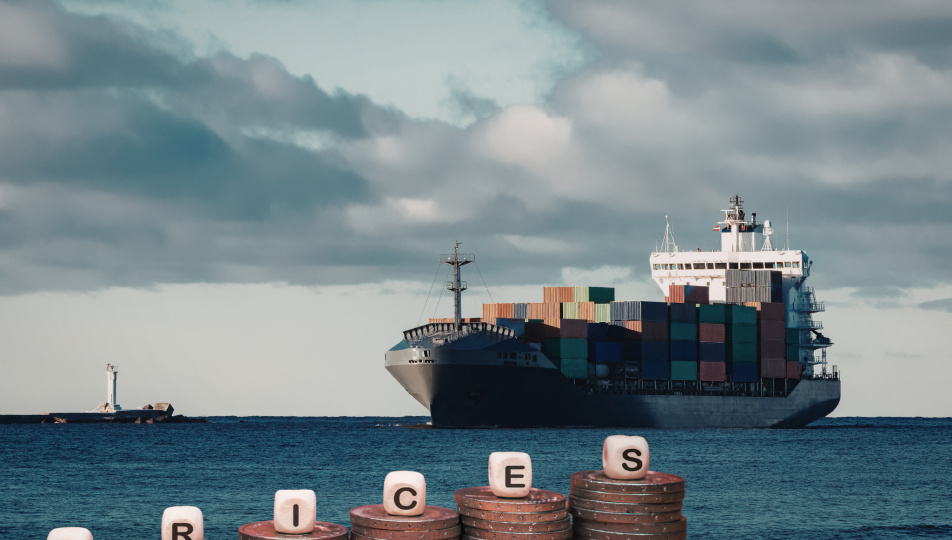
Dear business partners, The combination of military escalation in the Middle East, record fuel prices, the end of a difficult winter season in European ports, and ongoing repairs to the railway infrastructure in Germany is keeping the entire supply chain on alert, leading us to predict unpredictability and volatility. The pressure for flexibility in planning is growing again. Below is a key overview of the situation across all modes of transport.
OCEAN TRANSPORT
Shipowners face not only security threats, but also high operating costs.
In our last newsletter, we mentioned that one of the causes of complications is, among other things, the stranding of approximately 150 container ships in ports beyond the Strait of Hormuz. These ships, with a total capacity of around 135,000 TEU, are simply missing from the market, and at the same time, shipowners have to deal with security risks. These risks are still serious and do not only affect ships that want to pass through the otherwise closed strait. On Wednesday, March 11, Japanese shipping company ONE also learned this lesson when its ship ONE Majesty, anchored in the Gulf, was damaged in one of the attacks. Although the crew is safe and unharmed, the news is still disturbing because it shows that even ships that are not attempting to pass through the Strait of Hormuz are now targets of attacks.
As we reported earlier, shipowners are passing on these costs in the form of security surcharges.
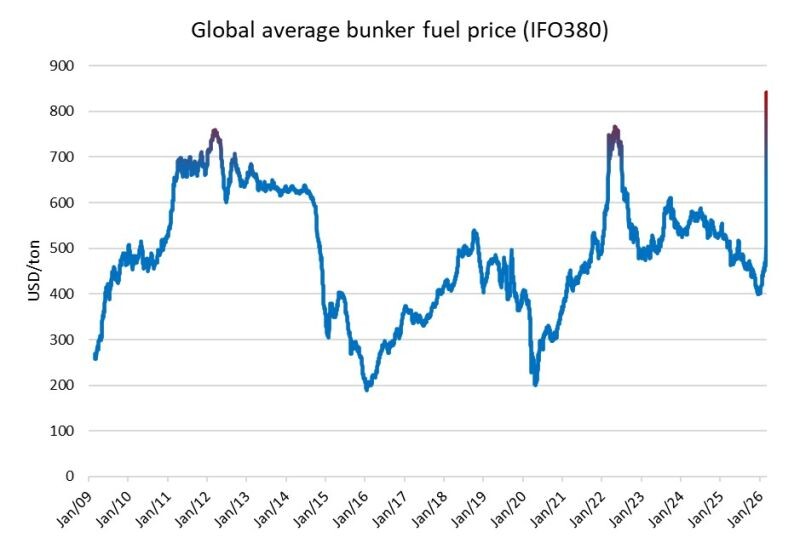
The price of fuel is a key component of maritime transport costs. Various shipping companies use standard indices for pricing on different services. These have been rising sharply in recent days, negatively affecting maritime rates.
This is well illustrated by the IFO380 fuel price chart below. IFO stands for Intermediate Fuel Oil, a type of blended marine fuel commonly used in shipping, which is produced by mixing heavy residual fuel oil (HFO) with lighter distillates (such as marine diesel oil), and the index has been in this form since 2008. The current level of USD 841.50/t is historically the highest and has surpassed the previous maximum of USD 760/t from the energy crisis of 2022.
Shipowners are again reflecting these higher costs in fuel surcharges under various names such as EFS, EBS, etc. Due to their immediate validity, these can also be reflected in already booked shipments. Their amount currently varies among shipowners, ranging from $85 to $200 per TEU, but this may not be the final figure.
At the same time, shipping companies are adjusting FAK (Freight All Kinds) prices, and with limited validity, MSC, for example, increased these rates by +$700/40' container from March 22 compared to the previous period. Other shipping companies are increasing prices with the help of PPS (Peak Season Surcharge) surcharges.
Customers, freight forwarders, and shipping companies continue to deal with the complex situation regarding goods traveling to and from the Persian Gulf region. Most services are completely suspended, and where they are operating, the conditions for port collection and return (demurrage, detention) are very strict and costly. For example, the service to Sohar with three free days in port operates at a rate of 11,000 OMR/day (1 OMR = 2.24 EUR) from the fourth day and 22,000 OMR/day from the eighth day.
All this in an environment where importers from the Persian Gulf have learned that containers must be returned not in the Persian Gulf, but in Salalah, Jeddah, or Sohar.
The situation seems to have angered port workers in Zeebrugge and Antwerp the most, and they have gone on strike. Control towers in these ports are not functioning, and the duration of the strike is still unknown. It is expected to peak on Thursday, March 12, and then everything should gradually return to normal. Tuesday's reports spoke of 60 ships waiting to anchor and unload, so it is certain that it will take several long days to clear this backlog.
HOLIDAYS IN BANGLADESH

AIR TRANSPORT
The actual situation in Europe is dominated by a strike announced at short notice, while relative chaos persists in Asia.
The crisis in the Middle East continues to affect air transport. Like shipping companies, airlines are struggling with completely closed airports and airspace in the region. Airports in Doha (DOH) in Qatar, Bahrain (BAH), and Kuwait (KWI) are completely closed. Iran and Iraq are probably not even worth mentioning. Israel is also practically inaccessible by air in terms of cargo, with only the evacuation of tourists being possible.
Partial operations are possible mainly thanks to repatriation flights at airports in Dubai (DWC, DXB) and Abu Dhabi (AUH). In certain cases, their space can be used for exports, but it is necessary to expect adequate prices, which are significantly higher than in normal times.
The area is therefore mainly served by flights via Saudi Arabia - Jeddah (JED) and Riyadh (RUH) or Oman, Muscat (MCT). However, flights are routed via a longer corridor, so longer transit times and increased costs must be taken into account.
Of course, airlines are also reflecting the increase in fuel prices and longer routes due to changed corridors that must avoid the Persian Gulf region in their prices.
Of course, airlines are also reflecting the increase in fuel prices and longer routes due to changed corridors that must avoid the Persian Gulf region in their prices.
This has been particularly noticeable to customers paying import rates from Taiwan, the Philippines, and even Bangladesh, where the aforementioned holiday also contributed to a 300% increase in import air rates compared to standard rates. Surprisingly, China has kept price increases relatively low.
In addition to oil prices, the US-European trade lane continues to be affected by earlier snowstorms on the east coast. We are still encountering a lack of capacity for onward transport to and from airports, as they are busy clearing the backlog. Let's hope that at least this situation will be resolved soon.
As with maritime transport, one link in the chain has decided to spice up the situation with a strike. It is none other than the pilots of Lufthansa and Lufthansa Cargo. From Thursday, March 12, 2026, at 12:01 a.m. until Friday midnight, they and their cargo space cannot be counted on, and the already limited capacity will decrease even further.

RAIL AND INTERMODAL TRANSPORT
Rail transport from China is closely linked to sea transport. The response is somewhat delayed, but since the COVID-19 pandemic, it has become clear that as soon as the price of sea transport rises, customers will start looking for other alternatives, as the "surcharge" for shorter transport times is no longer so high.
This is no different now. There are only a few empty slots left on trains at the end of March, and April capacities will soon start to fill up. Silk Road operators are responding with a slight increase in prices.
A new development for rail transport from China is the requirement to install digital seals for transit through Belarus.
On February 11, 2026, a new phase of the agreement between the countries of the Eurasian Economic Union (EAEU – Russia, Belarus, Kazakhstan, Kyrgyzstan, Armenia) on the mandatory use of navigation seals for tracking transit cargo came into force.
What is it about? It is an electronic device with a GLONASS/GPS module that is physically attached to containers or cargo spaces. Location data is sent to the monitoring center in real time (every 15 minutes in Belarus).
This applies in particular to sensitive goods such as electronics or engineering parts.
The cost of this measure can be as high as USD 600. We verify the necessity of such a charge and measure for a specific shipment based on the HS code before implementation.
Unfortunately, for intermodal transport to and from European ports, it is also likely that operators will pass on fuel costs to their sales prices. They usually do so in advance, but it is good to keep in mind that if they announce a price adjustment, for example, from April 1 or 14, it will already affect containers heading to Europe from Asia.

We are still waiting for an optimistic newsletter full of good news. But let's conclude by saying that train transport from China now has stable transit times. The rise in (crude) oil prices stopped on Tuesday morning. And these are the first signs of recovery. We will be watching for more with you.
Other articles

The EUDR Regulation and the Important Date of December 30, 2026
Effective December 30, 2026, the deferred EU Deforestation Regulation (EUDR) will take effect. For importers, this means one crucial thing: without a due diligence declaration number, customs authorities will not release the goods in question into free circulation.

Newsletter 08/2026: New Packaging Requirements: Everything You Need to Know About the PPWR
With the summer months still in full swing, some of you may think of other summer activities (such as packing a suitcase) when the word “packaging” comes up, but for our newsletter and for you, our readers and customers, what matters is the packaging of goods and packaging in general. What have lawmakers in store for us in this regard?
Extraordinary Newsletter 07/2026: Typhoon Saudel—Suspension of Port Operations in China
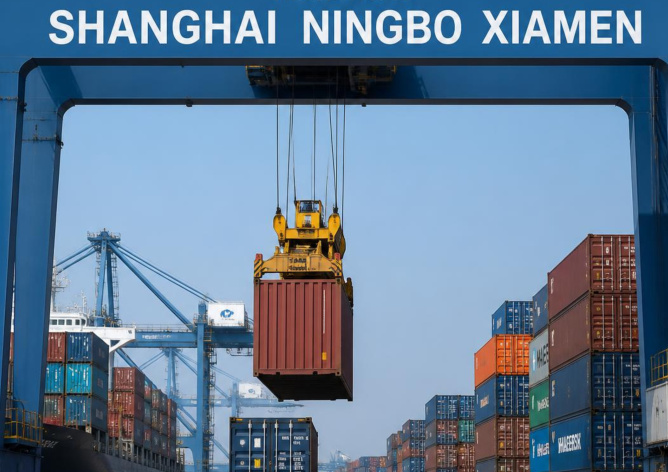
It is our regret to inform you that, as a result of the new typhoon Saudel, operations at the ports of Shanghai and Ningbo have been suspended as of this afternoon. The port of Xiamen is also expected to be affected. Consequently, there will be corresponding delays in the ships’ schedules.