Newsletter 10/2026: Actual Situation in International Transport
The fall newsletter features reports on the return of ships to the Suez Canal, a lengthy military exercise restricting access to ports in the southern Yellow Sea, and a look at the Persian Gulf as well as the U.S.
OCEAN TRANSPORT from the Far East and return to Suez
Earlier assumptions that shipping companies would proceed cautiously and gradually when returning their ships to Suez—and that they might wait until European ports were ready to handle additional capacity—are slowly being disproved. The return of container ships via the Red Sea and the Suez Canal is proceeding more quickly and on a larger scale than was expected even recently.
Let’s take a closer look at why this is happening, despite the factors mentioned above and the ongoing security situation in the Middle East.
Anyone who remembers the beginning of the return to sailing around Africa will surely recall the sudden price spike caused by a loss of capacity, which “disappeared” precisely because of the longer transit time for each ship. The service cycle is simply longer, and the frequency is lower.
However, since then, transit times have worsened again, partly due to global port congestion. Moreover, each day of transit consumes additional capacity. And current statistics are not at all favorable in this regard.
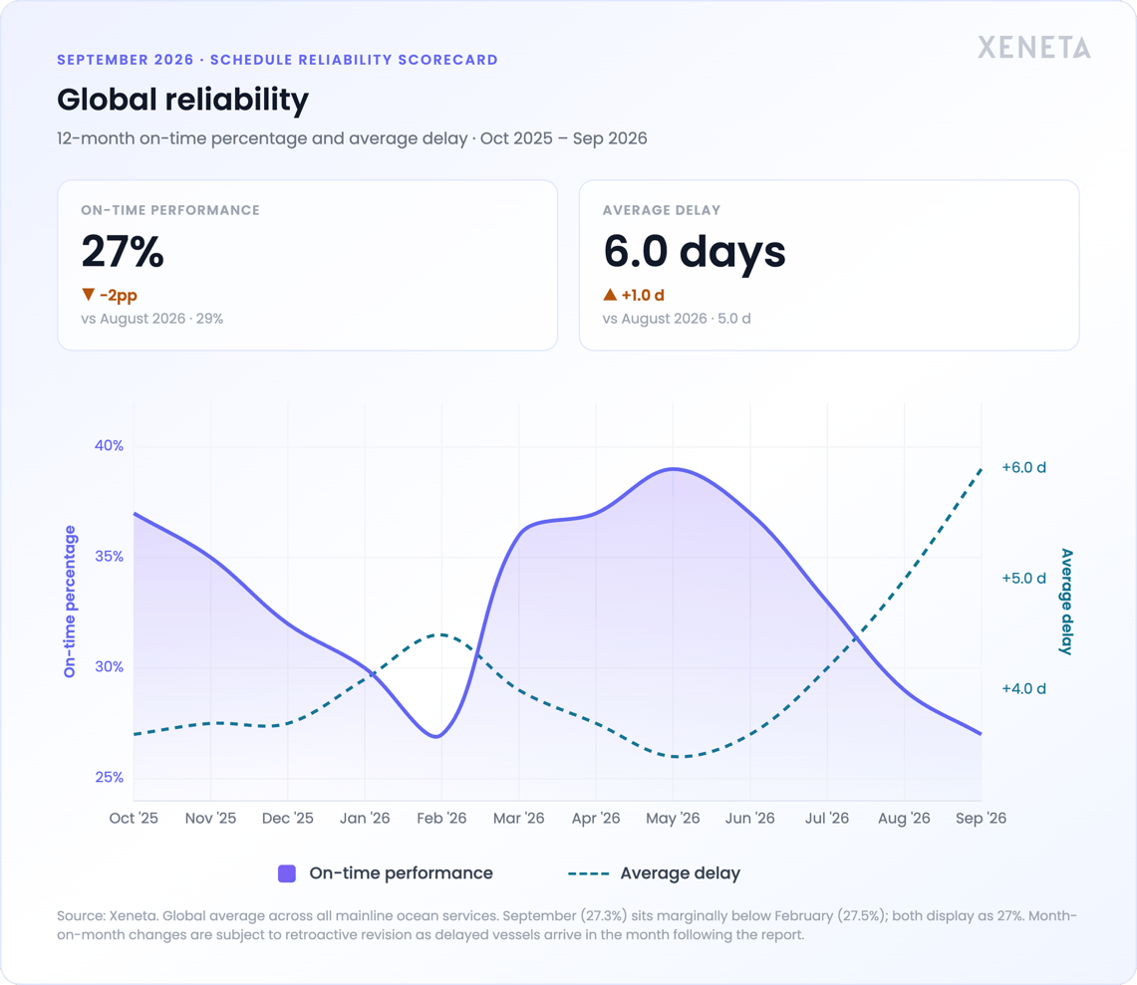
According to the Xeneta analytics platform, global reliability stands at 27%.
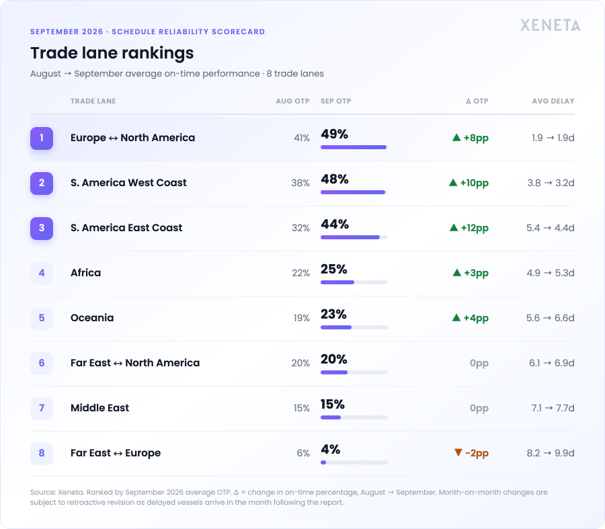
The Far East–Europe trade route is performing the worst of all those monitored. On-time arrival rates on the Far East–Europe route plummeted to 4% in September, with an average delay of 9.9 days for all vessels, marking the worst month since September 2021.
So, on the one hand, we have dwindling capacity. Let’s look at the other side, which is demand. In Ostrava, Christmas lights are already being hung around the trees, and after our Christmas, the Chinese New Year celebrations will follow. Those begin on February 6, 2027, so we can expect demand to increase in December—perhaps even as early as November. Shipping lines are well aware of this; the forecasts in this regard are clear. But that’s just one piece of the puzzle.
Another piece on the demand side is Africa. Shipping lines, of course, operate at full capacity and must manage it appropriately on a global scale according to the needs of individual markets. And Africa (at least sub-Saharan Africa), according to current estimates, will see steady GDP growth of 4.5%. In short, Africa is experiencing an economic revival, which is also linked to increased demand for shipping capacity. According to the outlook from the analytical firm Drewry, Africa’s demand for shipping capacity will jump by +3.1%, compared to +0.8% in Europe. And on specific routes, the increase is even more pronounced: West African container throughput in 2025 rose by 19.4%, and deployed capacity on the Asia–West Africa route is growing by more than 34% year-over-year.
Now, thanks to the return of vessels and the reduction in transit times, some of the “lost” capacity that shipping lines need to meet global demand is actually returning to the market. However, part of this capacity is currently being absorbed by congestion in Asian and European ports, as well as by delays and canceled sailings. This time, we won’t go back that far in history, but let’s recall the period following the realignment of alliances in 2025, when it took about a year for the new services to “settle in” a bit. Changes to shipping schedules are simply never easy and inevitably bring delays and complications. To be optimistic in this regard and think that things will be different this time is, at the very least, naive. Moreover, not only because of the adjustment of new schedules but also due to the aforementioned congestion, shipping lines plan to cancel voyages in November representing approximately 10% of market capacity. A return via the Suez Canal therefore does not automatically mean that it will be easy to secure space on a specific vessel right away. After all, the situation remains somewhat unclear; the return is somewhat haphazard—sometimes an entire service line is resuming operations, while at other times only ad-hoc vessels are returning.
In addition to the above—which is one interpretation—current purely economic indicators and cost optimization naturally also support a return to the Suez. Given the sharp rise in fuel prices, which constitute a significant cost item, the shorter route through the Suez Canal has become more attractive from a simple mathematical standpoint. This is all the more true given that the Suez Canal Authority (SCA) is making great efforts to entice container shipping back through various incentives and discounts. This is simply irresistible, and as soon as one shipping line begins to optimize these costs, others follow suit to level the playing field.
According to data from Sea-Intelligence, the share of capacity transiting the Suez reached approximately 27% in September, taking both directions into account. The return is more pronounced on voyages from Europe to Asia than in the main direction toward Europe; among other things, shipping lines are thus returning ships and empty containers to Asian ports more quickly. At the same time, it probably goes without saying that the security situation remains unstable and can change practically overnight. In such a case, it is up to the shipping line to decide to choose a different route—that is, around Africa again—without further notice.
Military exercises in the southern Yellow Sea (Qingdao Port)
According to the China Maritime Safety Administration, the Yancheng Maritime Safety Administration issued Navigation Notice 171/26: From October 15 to November 30, 2026, it will close a portion of the southern Yellow Sea to all vessels 24 hours a day for 47 days—an exceptionally long period. Around the same time, the Qingdao Maritime Safety Administration issued a notice specifying three waves of temporary military restrictions off Qingdao from October 21 to 24. The situation is leading to transit delays and traffic congestion in the Yellow Sea. In practical terms, this means the area remains in a “shooting may occur at any time” state throughout this period, so transiting merchant ships have no window of opportunity and must avoid the area entirely.
The area most affected: Lianyungang. The training area is located right next to the northeastern approaches to Lianyungang. Southbound voyages (to Shanghai, Ningbo, and Southeast Asia) face the longest detours and are typically delayed by 0.5–2 days. Pickup, loading, and customs operations at the terminal are proceeding without interruption.
Moderate impact: Qingdao. Northern routes between Japan and Korea run well north of the restricted area and remain stable; however, ships heading south to Shanghai, Ningbo, southern China, Southeast Asia, and the Middle East must divert east or west within the restricted area, which typically adds a few extra days to the voyage. At the same time, shipping lines may charge ad hoc surcharges for the detour based on fuel consumption.
Minor impact: Shanghai, Ningbo, and ports in the south. Northbound voyages must avoid the controlled area; however, deep-sea routes from Shanghai/Ningbo to Europe, North America, and Southeast Asia pass through the East China Sea and largely bypass this area.
The Persian Gulf and the United States
The Port of Jebel Ali is practically inaccessible directly. The solution is to choose ports such as King Abdullah or Dammam as the final destination and then leave the transit arrangements to the recipient, or arrange for transport to Jebel Ali via land.
The Port of Jeddah is accessible, but due to security risks, prices throughout the region have skyrocketed again.
On the other hand, the EU-U.S. export trade lane brings positive news. The long wait times for available ships seen in the past are gone; the situation appears stable and favorable for exporters. In fact, the infographic above regarding ship delays on individual trade lanes speaks for itself. Europe–North America is the most stable in this regard.
Intermodal Transport: European Ports
A return to shorter routes may shorten the voyage, but it will not eliminate terminal congestion or the uneven arrival of ships. Statistics from October 20 show that some terminals in Rotterdam are operating at around 90% capacity, with ships waiting an average of nearly two days, and that Bremerhaven is also operating at approximately 90% capacity. Hamburg isn’t far behind, and just when the situation happens to improve, some mishap occurs—such as the suspension of rail transport to and from the CTT terminal due to a train derailment on October 21, 2026. We are striving to continuously update the current situation in our eSTONE system, under the News section.
The Port of Bremerhaven is also currently experiencing a wave of increased customs inspections, primarily due to the requirement to pre-declare HS codes in the customs system. While this requirement is not new—and you are already familiar with it from us—German customs officials are now conducting more rigorous inspections of goods. This is particularly the case when the packing list and B/L indicate multiple types of goods, but only one main HS code has been reported to the customs system in accordance with previous practices. We therefore strongly recommend listing all items to minimize this risk. The wait for such an inspection can last several weeks, and the resulting storage costs can be significant.
AIR TRANSPORT
Air freight imports from China are dealing with a backlog of goods following Golden Week. As a result, capacity is fully utilized, which is driving prices up. At the same time, reports that Frankfurt is running low on jet fuel aren’t helping either; airlines are therefore reducing capacity on EU trade lanes because they fear they won’t be able to refuel for the return trip—or, if they can, it will be expensive.
At the turn of October and November, the summer flight schedule traditionally switches to the winter schedule, which generally results in a reduction in capacity.
As with maritime transport, the Persian Gulf is a challenge. Riyadh was the first airport to become unavailable, followed shortly thereafter by Dammam and Jeddah. The region is now served via Dubai and Abu Dhabi, and unsurprisingly, this is having a negative impact on prices.
The situation is relatively calmer and more stable—both in terms of capacity and price—on the import route from the U.S.
RAIL TRANSPORT from the Far East
If there’s one area where stability can be said to exist, it’s rail transport—at least for now. This holds true both in terms of pricing—although a slight increase in container rates is expected in November—and in terms of transit time, which remains at 30 days door-to-door. The increase in rates is most likely due to higher demand, which is also slightly extending the wait time for customs clearance.
It is certainly also worth mentioning the increased frequency of inspections on Russian territory, which we are anticipating by thoroughly checking HS codes against the most up-to-date sanctions lists. Even so, we may not be able to avoid them if the inspected goods are on the same train set (2 containers/1 train set).
Operators are still working on improving throughput along the southern corridor. This is certainly a welcome alternative in terms of avoiding Russian territory and sanctions; however, we will remain cautious in our offerings, as the winter season is not particularly favorable for this route.
ROAD TRANSPORT - Turkey (train alternative)
There are still significant delays at the Turkish-Bulgarian border, and transit times can easily reach one month.
Although there is a shortage of containers at the Halkali rail terminal (perhaps due to the aforementioned issue), a container can be brought in from another terminal for a small additional fee. For larger volumes, this is a suitable alternative and solution in terms of both time and cost.